
The most expensive gaps in your financial life are the ones no one owns
Ask most people who manages their money and you’ll hear a familiar list: a financial advisor for the investment accounts, an insurance agent somewhere for the life policy, a different broker forhealth coverage, maybe a CPA at tax time, and — once they turn 64 — a scramble to figure out Medicare on their own. Each of those professionals is competent inside their lane. The problem is what happens between the lanes.
A rollover decision made without regard to your tax bracket. A life insurance policy sized for a life stage you left a decade ago. A Medicare election that quietly raises your premiums because no one connected it to your retirement income. These aren’t failures of expertise — they’re failures of coordination. And coordination is exactly what a fragmented financial life can’t provide.
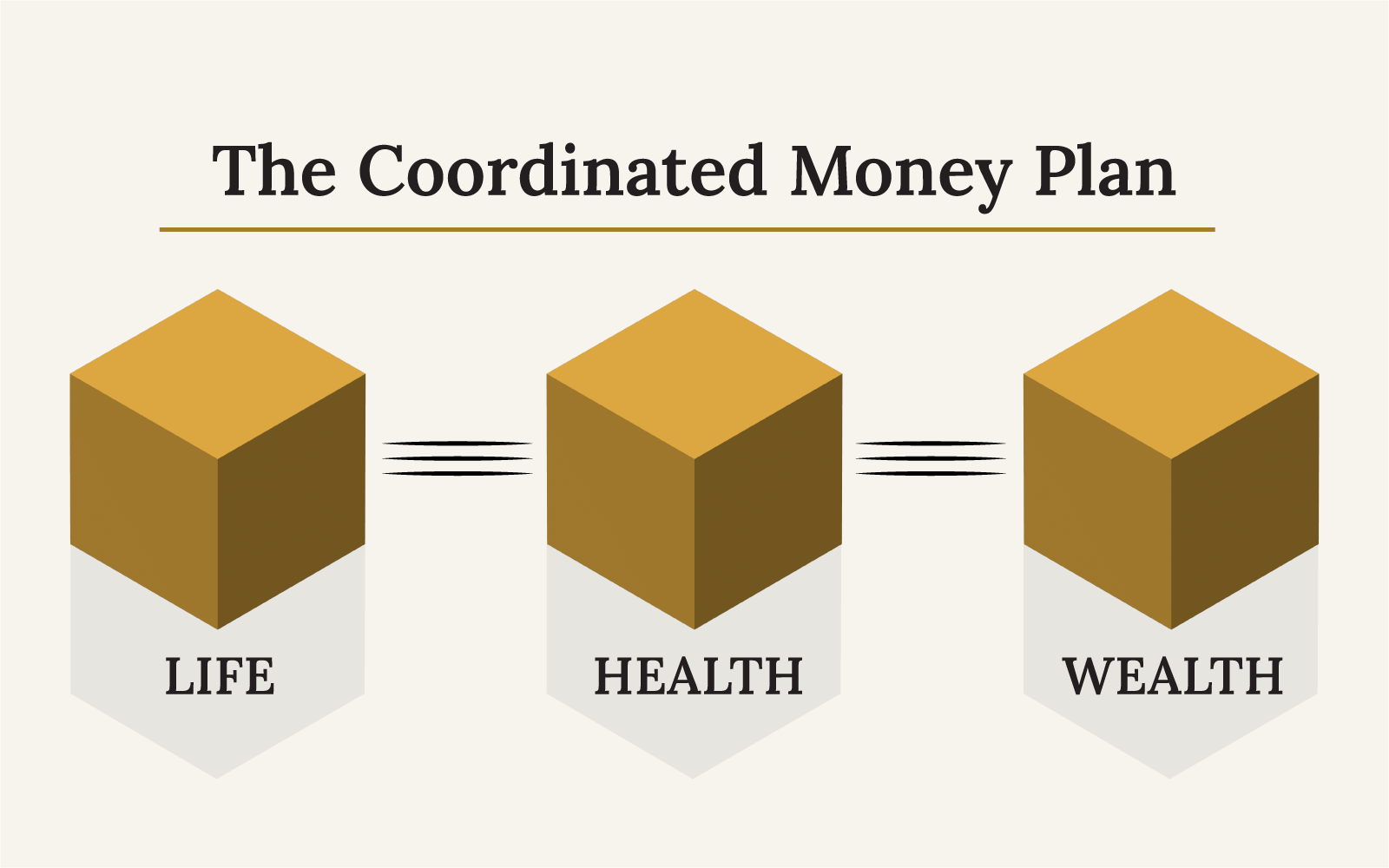
At Swarm Financial, we organize everything around three domains — Life, Health, and Wealth — and we plan them as one connected picture, with one team. This article explains what that means, why the seams between financial products cost families the most, and how a coordinated plan changes the math.
Life, Health, Wealth: three domains, one plan
The three words on our homepage aren’t a slogan; they’re how we structure advice.
Life is protection — the decisions that keep a setback from becoming a catastrophe. Life insurance, disability and income protection, long-term care planning, and the estate-minded basics (a will, beneficiaries, powers of attorney). Life planning answers a blunt question: if something happens to me, does everyone I love still land safely?
Health is coverage — health insurance during your working years and, later, Medicare done right. The Medicare maze alone (Advantage vs. Medigap, Part D drug plans, enrollment windows) sends most people searching for a guide. Health decisions are financial decisions: a wrong Medicare election or an uncovered health event can undo years of careful saving.
Wealth is growth and income — investment management, retirement-income planning, Social Security timing, annuities where they fit, and tax strategy. This is the domain most firms focus on exclusively. It matters enormously. But on its own, it’s only a third of the plan.
The point isn’t that these are three separate services you could buy à la carte. It’s that the right answer in one domain depends on the other two. How much life insurance you need depends on your wealth. When you claim Social Security interacts with your Medicare premiums
(through income brackets called IRMAA). A Roth conversion in your early 60s can lower your future Medicare costs. Handle these in separate silos and you leave money — and confidence — on the table.
Why coordination beats a collection of specialists
Swarm was built on a simple observation from the natural world, and it’s where our name comes from: migrating birds, ant colonies, and beehives coordinate through constant feedback so that each individual does better than it ever could alone. Collective intelligence outperforms isolated effort.
A coordinated financial plan works the same way. When the professional handling your investments can see your insurance and your Medicare election — and vice versa — decisions stop contradicting each other. A few concrete examples of the “between the lanes” value:
- Tax-aware retirement income. Drawing from the right accounts in the right order can meaningfully change your lifetime tax bill. That decision needs your investment picture and your tax picture in the same room.
- Social Security and Medicare together. Claiming age affects your taxable income, which affects your Medicare premiums. Coordinated, these are one decision — not two.
- Protection sized to the plan. As your wealth grows, your insurance needs change. A coordinated review right-sizes coverage instead of leaving you over- or under-insured.
- One point of accountability. When a life event hits — a new baby, a job change, a diagnosis, a market drop — you make one call, not four.
What a coordinated plan looks like at Swarm
Independence matters here. Since our roots in the Reaves Agency (est. 1969), we’ve stayed independent and unbiased with respect to financial carriers and products — we’re not captive to any one company’s lineup, so recommendations fit you, not a sales quota. With offices in Atlanta, GA and Lexington, SC, our roots are planted to serve individuals, couples, families, retirees, and business owners across the Southeast.
A coordinated engagement typically moves through four steps: listen first (your goals and the forces driving them), map the three domains (where you stand on Life, Health, and Wealth today), build the connected plan (decisions sequenced so each supports the others), and stand
alongside you as life changes. We measure success the way you do — by the well-being and confidence you and the people you love actually feel.
Is a coordinated plan right for you?
If your financial life is simple and entirely in one domain, a single specialist may be all you need. But if you’re juggling investments and insurance and an approaching Medicare decision — or you simply don’t want to be the one stitching four professionals’ advice together — coordination is where the value is. It’s most powerful at life’s inflection points: starting a family, selling a business, the decade before retirement, and the transition through 65.
The takeaway: most firms optimize one domain and hand you off for the rest. A coordinated plan treats Life, Health, and Wealth as one connected system — which is exactly where the biggest, most avoidable costs are hiding. Curious what coordination would change in your own plan? Let’s get started — or begin your pursuit with a short intake so we can point you to the right first conversation.